
JUMP TO
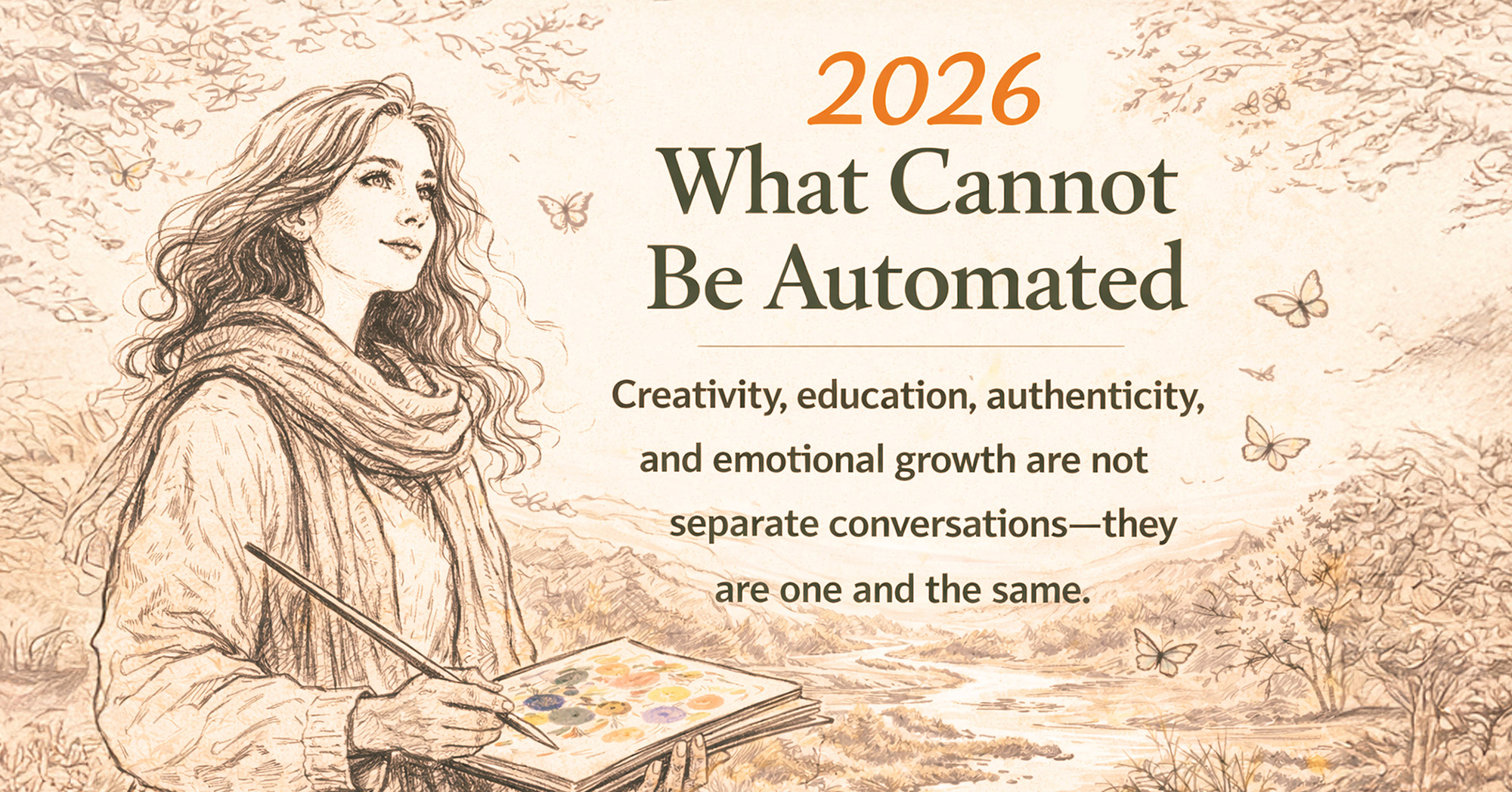
2026 is not asking us to do more. It is asking us to be more present. As the world accelerates, this year invites a return—to creativity, curiosity, health and authenticity. In education, art, and life, what matters most is not speed nor perfection, but depth, meaning, and integration.
Let this be the year you pause, reflect, and remember who you were before life taught you to abandon yourself. Perhaps too poetic? But it is grounded, centered, human-first, and powerful.
Survival: Before We Forget Who We Are
In the rush of modern life, and to so-called overnight modern success, we slowly create holes in our hearts. They don’t appear overnight. They form quietly—between deadlines, expectations, performances, and the pressure to keep up.
Eventually, that emptiness and rush shows up on our faces.
If you look closely, you can see it. I’ve seen it clearly in the eyes of my students, the colleagues I worked with, and in people I once knew well.
So what do we do when we feel this inner erosion?
- We run even faster.
- We perform even harder.
- We hide behind more social masks.
- We distract ourselves with busyness, filling our schedules to avoid the silence.
- We avoid confronting our emotions, fearing that they will overwhelm us.
And little by little, we become numb.
Numbness is not laziness; it is not procrastination.
It is the disconnection between who we truly are and who we think we must become to survive.
This disconnection can lead to a sense of emptiness, as we suppress our authentic selves in favor of societal expectations. We may find ourselves going through the motions, lacking passion and joy, as we prioritize survival over true growth and self-expression.
Creativity: A Way Back
Bringing creativity back into our lives is not about making art “better” or producing more content. It is about reviving the very essence that flows through us. Creativity reconnects us to feeling, to meaning and presence.
Creativity is not a luxury—it is a human biological need.
- When we create, we pause from noise.
- When we create, we listen to our dreams.
- When we create, we remember ourselves.
- When we create, we foster innovation by generating ideas that can lead to change and progress.
- When we create, we cultivate mindfulness, grounding ourselves in the present moment.
This is your invitation to pause, reflect, and reconnect—not with productivity, but with your inner life. In a world that often prioritizes productivity over expression, you must learn to honor your creative instincts as vital to our well-being and growth.
Question: Learn to Ask The Great Questions
Learning today is no longer about rushing to the correct answer. It is about learning how to ask meaningful questions.
Critical thinking and creativity go hand in hand. Critical thinking gathers scattered thoughts and turns them into focused creation.
When students learn to question, reflect, and stay curious, learning transforms from a task into a lifelong skill.
If you are a student, these are powerful questions to bring into the classroom:
- How can I add more creativity to my work?
- How can I become curious when the material feels complex?
- How can I develop patience when I don’t understand something?
- How can I use mistakes as part of my learning process?
- How can I enjoy learning instead of rushing to finish?
Parents play an essential role too. When adults model curiosity—wondering out loud, admitting uncertainty, showing patience—children learn that growth comes from experimenting, from inquiry, not perfection.
Only a handful of teachers truly teach how to learn. Those teachers don’t just deliver content; they nurture curiosity, imagination, patience, confidence, and joy.
These are the skills that do not expire. They are the skills that make learning deeply human.
Education: AI and Information
We live in a time where we have access to more information than any generation before us—more than our ancestors combined. And yet, something essential is missing.
Education, when reduced to the transfer of information—facts, formulas, frameworks, “right answers”—is no longer enough. The world is evolving faster than any curriculum can keep up with, and AI will only accelerate that reality.
What will truly set people apart is not what they know, but how the apply and adapt what they know:
- How deeply they understand.
- How well they know themselves.
- How creatively they think.
- How capable they are of learning, unlearning, and growing.
- How capable they are to collaborate, valuing diverse perspectives and fostering an inclusive environment.
The most transformative learning does not come from memorization or blind execution. It comes from developing capacities that traditional education has often overlooked: Curiosity, Reflection, Imagination, Emotional intelligence and Meaning-making in a fast-paced world.
These are not “soft skills.” They are human skills. And no technology—no matter how advanced—can replace them.
This is why educators must evolve from being teachers of facts to mentors of being—guides who help students uncover their deeper human capacities.
Ultimately, what sets people apart is not just their achievements or accolades, but the richness of their character and the depth of their engagement with the world. In a rapidly changing landscape, it is these qualities that will lead to meaningful impact and lasting connections.
Emotional Growth: Only Integration
As the year ends, it’s natural to look back. Some memories bring warmth. Others still ache. Not everything turned out the way you hoped—and that’s okay. Every experience, even the painful ones, added another layer to who you are becoming.
Regret is a weed that overflows the creative thinking; in its traditional sense, regrets keeps us stuck. But re-framed through emotional maturity, “no regrets” does not mean denial—it means integration.
Emotional maturity looks like this:
- Feeling sadness without being trapped by it.
- Looking back without self-blame.
- Moving forward without erasing the past.
- Finding joy in the little things, even during difficult times.
- Embracing change as a natural part of life, rather than fighting it.
Emotional maturity looks like this: Jobs can end. Dreams can change. People can drift apart. And still—it was worth going through and feeling it.
Growth is not about having a perfect past. It is about having the courage to honor your lived experience with compassion. Ultimately, emotional maturity is about embracing the full spectrum of human experience with grace and resilience.
Authenticity: Before Life Taught You to Abandon Yourself
Authenticity is not a style, a role, or a personality. It is a vibration. A state of alignment where thoughts, emotions, values, and actions move in the same direction.
Before survival strategies … Before people-pleasing … Before self-silencing … There was an authentic version of you.
Life often teaches us to abandon ourselves—to ignore our needs, suppress creativity, cross our own boundaries just to meet expectations or avoid conflict.
The abandoned self:
- Gives too much, often at the expense of their own well-being.
- Silences their creative voice, fearing judgment or rejection.
- Avoids saying no, leading to overwhelm and resentment.
- Experiences chronic stress and burnout from overcommitment.
- Engages in negative self-talk, reinforcing feelings of inadequacy.
The authentic self:
- Fills their own cup first, recognizing that self-care is essential for giving to others.
- Honors the body and inner signals, listening to what they truly need.
- Sets healthy boundaries without guilt, understanding that it’s okay to prioritize themselves.
- Communicates openly and honestly, fostering genuine connections.
- Engages in reflective practices, gaining clarity about their goals and desires.
In life, authenticity creates inner calm—no fragmentation, no self-betrayal.
In art, authenticity carries a message. It doesn’t try to sell and impress; it transmits truth.
When we abandon ourselves, our energy fragments.
When we live authentically, our vibration becomes whole.
Coming back to authenticity begins the moment you stop abandon yourself behind.
This journey involves recognizing our passions, worth, honoring our needs, and embracing the fullness of our experiences. And of-course nurturing the body.
A Closing Reflection
Creativity. Education. Authenticity. Emotional growth. These are not separate conversations—they are one and the exact same. And, 2026 invites—to all this: creativity, curiosity and authenticity.
2026 invites you to work hard on yourself means paying attention to how you think, feel, create and react in everyday situations. It’s noticing your patterns—what triggers you, where you avoid discomfort, how you make decisions—and taking responsibility for them. Instead of blaming circumstances or rushing to change, you slow down, observe, reflect, and make conscious adjustments.
This kind of work builds self-awareness, emotional regulation, and better choices in learning, relationships, and life.
They ask us to slow down. To feel. To question. To remember who we were before the world told us who to be.
- They invite us to explore the depths of our imagination, where ideas flourish and innovation thrives.
- They encourage us to engage in lifelong learning, not just for knowledge, but for the joy of discovery and personal evolution.
- They challenge us to embrace our true selves, shedding the masks we wear to fit in or please others.
- They remind us that emotional growth is a journey, one that requires patience, reflection, and a willingness to confront our fears.
- They call us to cultivate spaces where creativity can thrive, where curiosity is nurtured, and where vulnerability is welcomed.
Ultimately, they remind us that in a world that often prioritizes productivity over expression, let us honor our creative instincts as vital to our well-being and growth. Being a creative human is not a flaw—it is the point.
As you move forward into the next season of your life, may you choose depth over speed, curiosity over certainty, and alignment over approval.
My Training Programs
- Mindset Training: A Self-Empowerment Journey
A personal development course designed for those who want more from life — clarity, balance, and a genuine inner strength. - Unlocking Creativity: Creative Training in Companies
A comprehensive approach that helps individuals unlock their creative potential by blending art, psychology, and cognitive science, enabling participants to harness their imagination and cultivate an innovative mindset. - Unlocking Creativity: Creative Training in Schools
Students shift from passively consuming digital media to actively creating digital art, enhancing their creativity and innovation. By empowering them to express themselves digitally, we prepare them to make positive contributions to the digital world. - Creative Digital Art: 1-on-1 Coaching
Creative visual arts are the foundation of the creative industries. Here, concept art and character animation are vital for bringing worlds to life. In my coaching, I focus on demonstrating the workflow and emphasize an iterative process of refining and improving ideas.